
Field notes
How to trace coffee and cocoa origin back to smallholder farms
How to trace coffee and cocoa to the smallholder plot: offline mapping, farmer consent, one record reused with consent. EUDR is one use case.
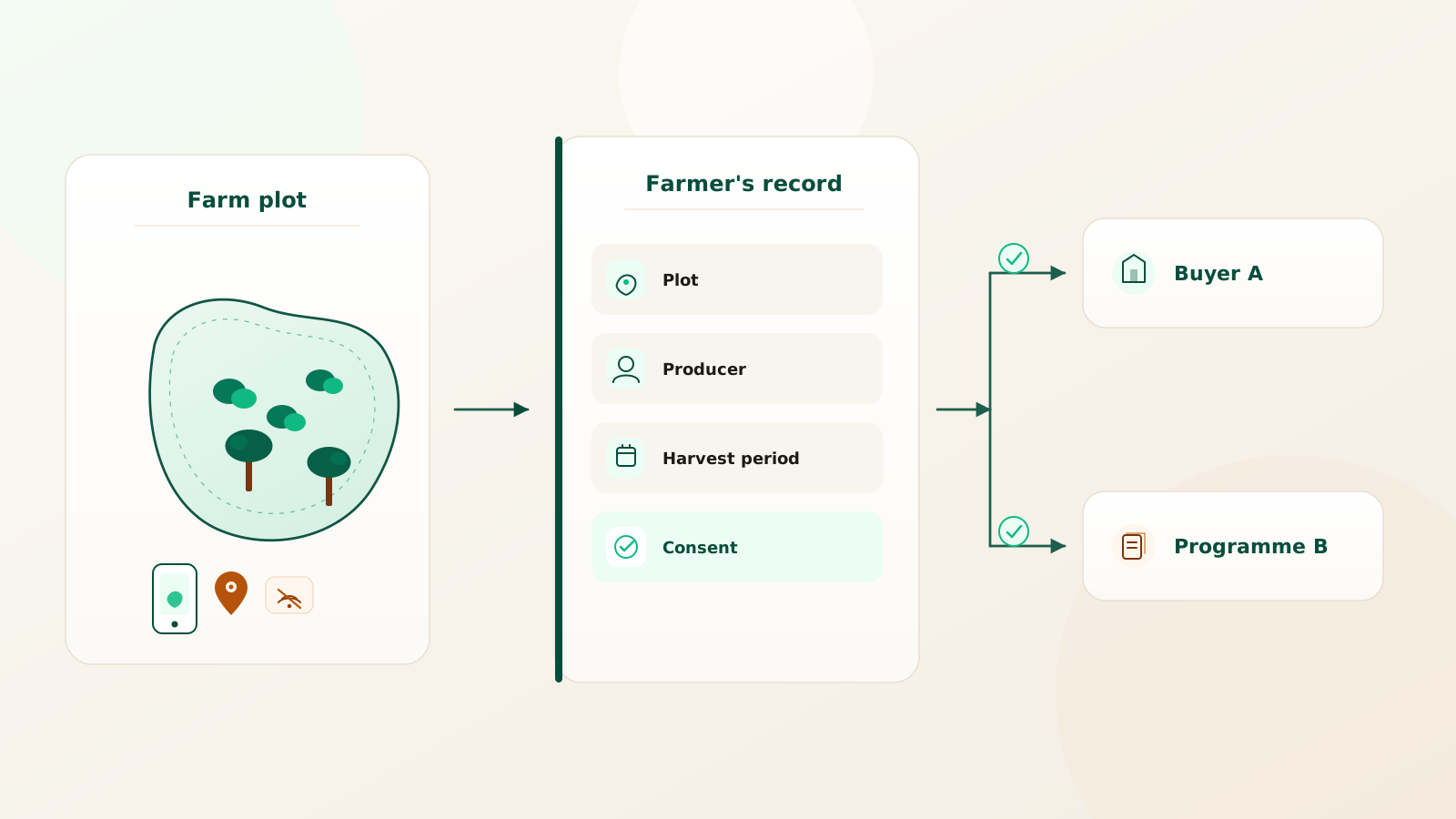
To trace coffee or cocoa back to a smallholder farm, you need a record for each plot, made in the field with the farmer. That record holds the plot boundary or point, the producer, the harvest period and the farmer's consent. Good software works offline and lets one record be reused for many buyers, with the farmer's consent. It also keeps every lot linked to the plots behind it.
What origin traceability to the plot means
Origin traceability to the plot means you can point from a lot to the land that grew it. A cooperative name or a region is not enough. You need the plot itself.
In practice, a plot record has five parts:
Geometry. A point or a polygon that matches the real plot.
Producer. Who farms it, and which commodity it grows.
Production period. The harvest window the volume came from.
Consent. What the farmer agreed to share, and with whom.
Provenance. Who captured it, when, how, and any later correction.
The EU Deforestation Regulation (EUDR) sets one strict version of these facts. It asks for coordinates with at least six decimal digits, and a polygon for plots over 4 hectares. We cover those rules in detail in What good EUDR plot-level geolocation and DDS evidence looks like.
Why smallholder origin is hard to trace
Most coffee and cocoa is grown on small farms. An International Coffee Organization (ICO) report puts the number of coffee farms at around 12.5 million. Depending on the definition, 67% to 80% of them are smallholdings. For cocoa, an UNCTAD presentation published by the International Cocoa Organization (ICCO) says smallholders grow about 80% to 90% of world production. An ICCO review estimates 5 to 6 million cocoa farmers.
So one lot can hold coffee or cocoa from many farms. Four problems come up again and again.
No signal. Many plots sit in areas without mobile coverage. A tool that needs live internet stops at the farm, while GPS still works there.
Paper records. Land papers, member lists and delivery notes are often kept on paper. They get typed in later, sometimes from memory, and errors often start there.
Many intermediaries. Coffee and cocoa pass through collectors, cooperatives, processors and exporters before they reach Europe. Each step can mix volumes. If the link to the plots breaks once, it is hard to rebuild.
Repeat data asks. A farmer may sell to more than one buyer and sit in more than one programme. When each one runs its own mapping visit, the farmer answers the same questions again, and the maps often don't match.
What a traceability tool needs to do
Capture plots offline. The farmer or a field agent should be able to walk or draw the plot with no signal, save it, and sync later. Our guide on how to collect farmer plot data offline for EUDR explains the field routine.
Store consent with the record. Plot locations and farmer names are personal data. Consent should sit on the plot record and travel with it.
Collect once, share many times. One plot record should serve every buyer or programme the farmer agrees to. When a buyer needs one more piece, such as a polygon instead of a point, the tool should ask for that piece only. The farmer should not have to start again. Read more in Field data for Rainforest Alliance, Fairtrade, and EUDR: collect once, mould many times.
Screen plots on the buyer side. Checks should run on the real plot records. Satellite layers help check a plot, but they cannot replace the record collected with the farmer.
Keep lots linked to plots. When deliveries are combined into lots, each lot should still list the plots it came from. That link has to hold through aggregation and processing.
Cost nothing for the farmer. If farmers must pay to document their own land, many will be left out.
How Tracebud traces origin to the plot
Tracebud is field data infrastructure for agri-food chains. It has two products that share one set of records: the Field App and the Dashboard.
The Field App is free for smallholder producers and the field agents who map for them, for life. They use it to:
- walk or trace a plot boundary, fully offline, on ordinary phones (Android 7 or later, iPhone on iOS 16 or later)
- add the photos, tenure papers, harvest vouchers and declarations a programme asks for
- keep delivery receipts in their own app, in fifteen languages.
When a producer has no smartphone, a cooperative field agent can capture the plot on their behalf. The record is kept under the producer's name. Producers see every organisation that asked for their record, and can allow, deny or revoke access at any time in the app. Nothing is shared by default.
The Dashboard is for organisations. A cooperative, exporter, importer or brand can import contacts by CSV. Existing plots can be imported as GeoJSON, KML/KMZ, Shapefile ZIP or CSV, in open beta. The organisation then sends one cascading request, which asks each link only for what is missing. Each plot is screened automatically against satellite deforestation alerts as soon as it is mapped. Plots that need attention go to a review queue. On the custody desk, the organisation receives deliveries, builds lots and ships them, and lots stay linked to the plots behind them.
Any actor in the chain can start, including a cooperative, with no setup project. Farmers never pay. Organisations pay from €5 per tonne (co-ops, processors, traders and brands), and €20 per tonne for exporters and importers. Their dashboards have no seat fees.
EUDR as one use case (open beta)
EUDR is the only framework live in Tracebud today. It is in open beta, starting with coffee and cocoa.
Under EUDR, operators must give the geolocation of every plot that produced the commodity in a due diligence statement (DDS). In the Commission text, EUDR applies from 30 December 2026 for large and medium operators. Micro and small operators follow from 30 June 2027. Tracebud prepares the Due Diligence Statement. The operator files it in the EU Information System, and the reference is stored with the record.
Other programmes ask for many of the same facts. Rainforest Alliance, Fairtrade, CSDDD, regenerative agriculture and living income are not live in Tracebud. We are building them with co-build partners on the same records, so the data collected now can carry over. A certificate also does not replace an operator's own due diligence under EUDR.
A short checklist for buyers choosing a tool
Use these questions in a demo or a tender:
- Can a farmer or field agent map a plot with no signal, and sync later?
- Does each plot record carry the producer, the production period and consent?
- Can one record be reused for several buyers and programmes, with the farmer's consent?
- When data is missing, does the tool ask for that gap only, without a full remap?
- Does screening run on real plot records, not only on map layers?
- Do lots keep the list of plots behind them through aggregation and processing?
- Who pays? Check that farmers pay nothing.
For a longer list focused on EUDR, see How to evaluate EUDR due diligence tools for SME coffee and cocoa supply chains.
FAQ
What is the simplest way to trace coffee back to the farm? Map each plot with the farmer present, and attach the producer, harvest period and consent. Then link every delivery to the plots it came from.
Can plots be mapped without mobile coverage? Yes. Phones record GPS positions without a mobile network. An offline-first app saves the plot and syncs it later.
Does the farmer have to be mapped again for every buyer? Not if the tool lets one record be reused with consent. In Tracebud, producers see every organisation that asked for their record. They can allow, deny or revoke access at any time in the app, and nothing is shared by default.
Is satellite data enough to trace origin? No. Satellite data helps check a plot for forest loss. It cannot show which plot fed a lot, or what the farmer agreed to share.
Does Tracebud cost anything for farmers? No. The Field App is free for smallholder producers and the field agents who map for them, for life. Organisations pay from €5 per tonne, and €20 per tonne for exporters and importers.
Is Tracebud only for EUDR? No. Any buyer or programme can use the field data, with the farmer's consent. EUDR is the first live use case, in open beta.
Sources
- International Coffee Organization, Report of the meeting of the Statistics Committee, 27 March 2019 (around 12.5 million coffee farms; 67% to 80% smallholders depending on definition): https://www.ico.org/documents/cy2018-19/sc-93e-report.pdf
- UNCTAD presentation (S. Gayi), published by ICCO ("Smallholder farmers: about 80 to 90 per cent of the world's cocoa production"): https://www.icco.org/wp-content/uploads/2019/07/1-Samuel-Gayi-Compatibility-Mode.pdf
- ICCO, A Global Review of Cocoa Farming Systems (an estimated 5-6 million cocoa farmers): https://www.icco.org/wp-content/uploads/Global-Review-of-Cocoa-Farming-Systems_Final.pdf
- Regulation (EU) 2023/1115 (EUDR), consolidated text on EUR-Lex (plot geolocation in the DDS; six decimals and polygons over 4 ha as summarised on the Tracebud evidence page): https://eur-lex.europa.eu/legal-content/EN/TXT/?uri=CELEX:02023R1115-20251226