
Comparisons
Self-serve agri-food-chain traceability is the future of EUDR readiness (and why big stacks fail SMEs)
For coffee and cocoa SMEs, durable EUDR readiness comes from a self-serve Field App and Dashboard with an access fee per tonne and a free farmer Field App, not satellite-only screens or closed portals.
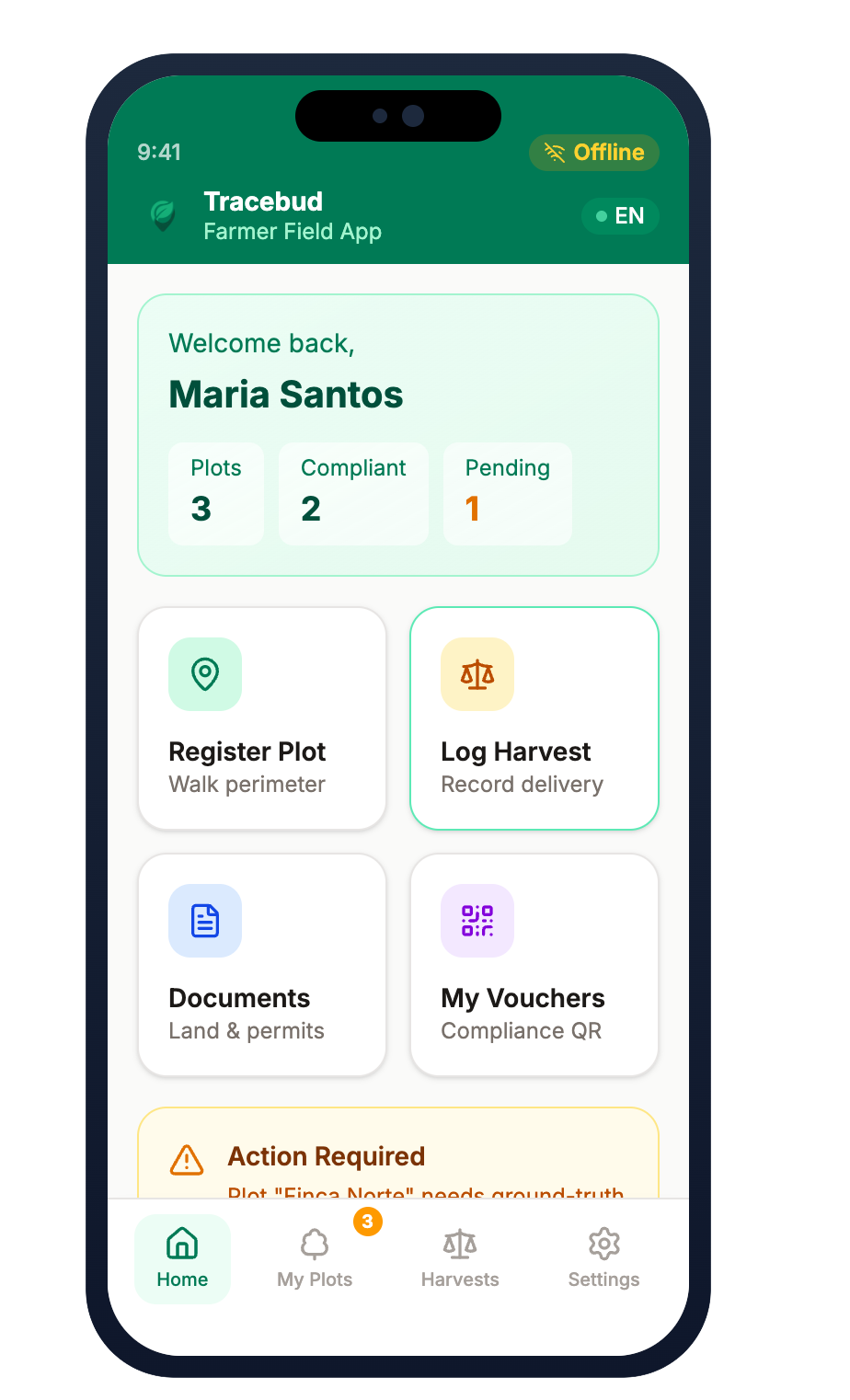
For coffee and cocoa SMEs, durable EUDR and programme readiness does not come from another satellite dashboard or a closed portal that farmers cannot open. It comes from a self-serve Field App and Dashboard that a cooperative or trader can run themselves, with an access fee per tonne and a free farmer Field App. That is the path that keeps first-mile data alive after the consultant leaves.
Satellite screens, closed cert portals, custom IT, and seasonal remapping programmes all solve a piece of the job. They leave a hole where the farm visit happens. Self-serve agri-food chain tools close that hole without dumping licence cost onto the farmer.
Tracebud is built for that gap: field-first capture, reusable records, then the packages buyers and programmes need.
What self-serve means
Self-serve means the cooperative, exporter, or SME runs the network. They invite farmers and collection points. They set who can see which plots. They pull the evidence pack when a buyer or a scheme asks. They do not wait for a vendor project manager to open another site.
Self-serve is not doing everything alone with no support. It is product path over project path. Most coffee and cocoa actors in Europe, Africa, and South America need something they can start this season, train in days, and keep using when staff change. Custom IT still fits very large operations. For everyone else, a product path is the only honest timeline.
The test is simple. Can a coop or SME run the network without a permanent implementation team on the vendor side? If the answer is no, it is not self-serve. It is a build you will rent forever.
Same-day desk path is part of that test. Sign up, create a workspace, import a CSV or add members by hand, and send your first campaign the same day, often in minutes. Field evidence can start immediately when producers or Field Agents are ready. Finishing every plot still depends on network size and field time; a small, ready network can collect the same day, while a large one spreads visits.
Why satellite-only is necessary but not sufficient
Satellite and geospatial layers matter. They help check a claim against land cover. They help risk screening. They belong in any serious EUDR stack.
Satellite without farm capture still leaves a hole. The regulation asks for plot-level geolocation tied to the product and to the producer. A regional map with a guessed centre pin is not that. A satellite check is not the same as walking the plot with the farmer, storing consent with the record, and keeping the geometry when beans hit a silo.
Geospatial tools are necessary. They are not sufficient on their own. First-mile capture and geospatial risk need to sit together, not compete for budget.
Why cert portals and consulting builds miss the first mile
Certification portals do useful work. Schemes help coops and brands with geodata and risk for Rainforest Alliance, Fairtrade, and similar programmes. That help does not replace the operator's due diligence statement. The schemes say so themselves. A portal built for one logo also rarely becomes the daily tool a field agent uses offline with a farmer who has never opened that portal.
When a producer has no smartphone, Tracebud Field Agents capture on their behalf: plot, photos, and consent stay under the farmer's name, not the agent's. Cooperatives and exporters invite those agents into their network so first-mile coverage does not stop at the phone gap.
Consulting and remapping programmes fail in a different way. They often create a clean snapshot for one buyer season. Then the staff rotate, the phone is recycled, and next year someone remaps. Dumping licences or app fees onto farmers breaks the first mile. Farmers will not pay for your compliance stack. That is not a culture problem. It is a design problem.
Custom IT for a multinational can work when there is a real platform team and a multi-year budget. Most coffee and cocoa SMEs do not have that. They need a product they can adopt, not a programme that leaves when the invoice stops.
Access fee per tonne + free farmer Field App
Cost has to follow the product, not the plot visit. An access fee per tonne aligns spend with volume that moves through the network. The farmer Field App stays free. That split keeps the first mile open.
Seat licences, per-farmer licences, and pay-to-see-your-own-plot models push cost onto the people least able to carry it. That is how first-mile coverage collapses just when EUDR needs it most.
Access fee per tonne is not a slogan. It is the commercial shape that lets a coop scale invitations without charging the producer for the right to document their own farm.
Offline · fifteen languages
EUDR plot data is collected where the bars disappear. Hills, plantations, village roads with no coverage. If your process needs live internet to finish a farm visit, you have already filtered out the hardest-to-reach producers.
Offline capture is not a nice feature. It is the job. Walk the plot. Save consent on the device. Sync when you are back in signal. Ask for a missing polygon or a consent refresh without remapping the whole farm.
Language is the same story. The Field App ships in fifteen languages: English, French, Spanish, Portuguese, Indonesian, Vietnamese, German, Dutch, Italian, Amharic, Hindi, Arabic, Kinyarwanda, Luganda, and Swahili. That is product, not a pilot promise. Field agents and farmers work in the language they actually speak. A tool that only works in English on good Wi-Fi is not ready for Africa, South America, or the rural producer end in Europe.
How Tracebud positions
Tracebud is programme infrastructure for the agri-food chain. It is not a certifier. It does not replace Rainforest Alliance, Fairtrade, MultiTrace, Fairtrace, or the EU information system. It helps you collect once at the plot and mould packages later for EUDR, schemes, and buyers.
Three layers sit together:
- First mile: farmer Field App (free), offline plot mapping, consent, Field Agents for producers without phones, cascading network requests so a missing piece can be asked without remapping everything.
- Downstream: Dashboard and network tools for coops, exporters, importers, and brands who need reusable EUDR-ready records and chain of custody. Identity preservation and segregation are available; CoC Mass Balance is scheduled.
- Geospatial: checks and risk layers that support the claim without pretending satellite alone is the farm boundary.
Records stay farmer-owned in the sense that consent and visibility travel with the data. Cascading requests beat remapping: when a buyer or programme needs a refresh, you ask for what is missing instead of starting from zero.
Tracebud partner work such as with the Coffee Change Fund sits in the same spine: digital rails under real farm programmes, not a new certificate stamp.
What buyers should ask any vendor
Before you buy another EUDR or traceability stack, ask for answers you can verify in a demo, not a slide:
- Who runs the network day to day: your team, or a permanent vendor project crew?
- Is the farmer app free, and does cost follow tonnes or farmer licences?
- Can a field visit finish offline, then sync, in the languages your agents actually use?
- Do cascading requests exist, or does every new ask mean remapping?
- Is geospatial paired with farm capture, or sold as a substitute for it?
- Are you buying programme infrastructure, or a closed cert portal, or a custom build that only large ops can staff?
- Who owns consent and who can see the plot when the bean moves?
If the answers point back to satellite-only screens, closed portals, custom IT for SMEs, or farmers paying to stay in the system, keep looking. Durable EUDR readiness for coffee and cocoa SMEs is self-serve agri-food chain infrastructure: Field App plus Dashboard, access fee per tonne, free for the farmer, offline where coverage fails, and reusable for programmes beyond one buyer season. Get started when you want to run that path yourself.