
Field notes
Who pays to prove origin? EUDR smallholder mapping costs, explained
Who pays to map smallholder coffee and cocoa plots for the EUDR? What IIED, CLAC and the Commission's 75% cost estimate show, and what they leave out.
Who pays to prove origin for coffee and cocoa sold into the EU? In the few numbers I can find, the answer is often the farmer, or the farmer's co-op.
The EUDR applies from 30 December 2026 for large and medium companies, and from 30 June 2027 for most micro and small companies. The legal duty sits with the companies that place coffee or cocoa on the EU market. The location data for each plot still has to come from the farm, and someone has to go there and collect it.
So I went back to what smallholders say themselves. In October 2025, IIED published an online survey of 286 smallholders. They were members of producer organisations supported by the Forest and Farm Facility (FFF), in 11 countries. Ghana and Ecuador made up the largest groups, with Tanzania, Vietnam and Nepal next. The report says plainly that it can't be representative of all smallholder producers. I still find it useful, because the farmers answer for themselves.
Almost half (48%) of all respondents had not heard of the EUDR.
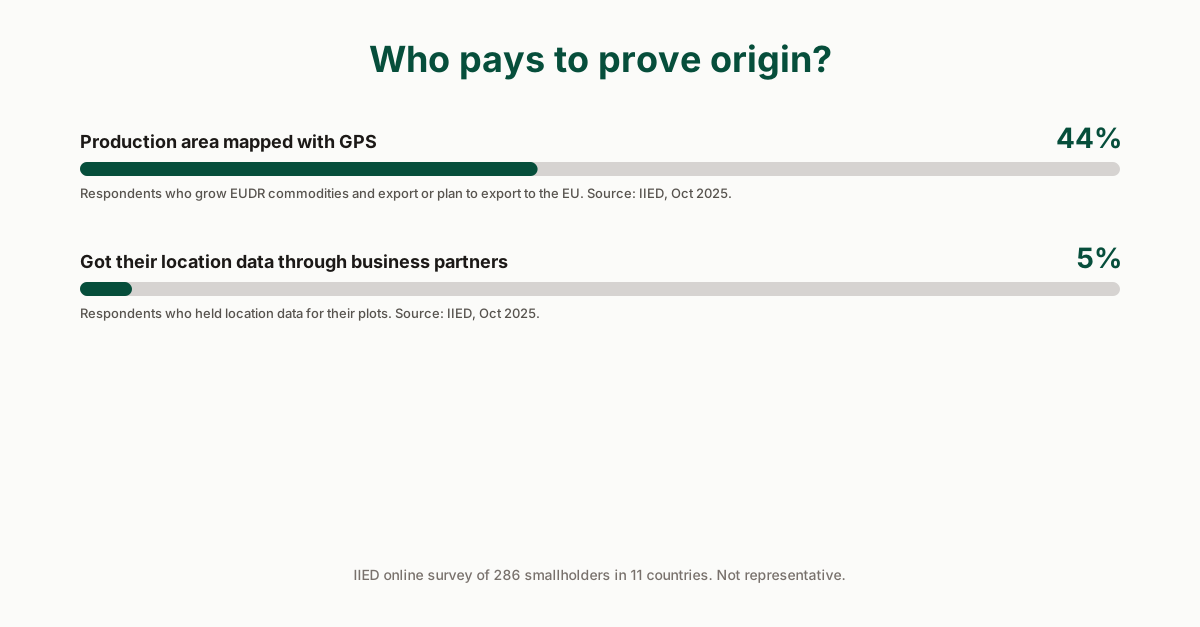
That's the whole sample. The next numbers come from a smaller group: respondents who grow EUDR commodities and export, or plan to export, to the EU. These are the farmers closest to the EU market. In that group, only 44% had their production area mapped with GPS, by themselves or by someone else. And 30% of the same group do not own or have access to a smartphone. IIED calls a GPS or smartphone "a fundamental tool" to record location data.
Land is the next question. Over 48% of all respondents did not hold land titles. IIED notes that titles are not strictly required under the EUDR. For a farmer who has never heard of the law, it's still one more paper to worry about.
The survey also asked where location data came from. Of the respondents who held location data for their plots, only 5% got it through their business partners, the companies they sell to. Almost a third got it through a producer organisation, and another third through an NGO. IIED calls the 5% "a surprisingly small number", since the EUDR's planners expect business partners to carry overall responsibility for due diligence.
If producer groups and NGOs do most of the mapping, who covers the cost? A report by CLAC, the Fairtrade producer network for Latin America and the Caribbean, gives some figures. It came out in April 2026 and looks at small coffee and cocoa producer organisations, based on interviews. CLAC estimates georeferencing costs from $15 per geographic point to $60 per polygon for its organisations.
One case stayed with me. A cocoa co-op in Peru, with about 600 members, spent between $60,000 and $100,000 on its EUDR process (images, maps and computer systems). That is about $100 per producer. The co-op had the money, but it paid part of it from its Fairtrade Premium.
These are interview cases, not statistics, and CLAC says so. Still, they show who ends up paying. CLAC writes that new regulatory obligations have increased co-ops' costs "without compensation in the sale price".
The company side looks very different. On 4 May 2026, the European Commission published its simplification review, COM(2026) 191. It estimates that the simplification measures taken since April 2025 cut annual compliance costs for companies with EUDR obligations by about 75%, from EUR 8.1 billion to EUR 2.0 billion per year. The figure covers running costs and leaves out spending on new systems. For those companies, it's good news.
The same estimate does not measure costs borne by the non-EU smallholders who supply them. Those farmers are not operators under the EUDR, so the count leaves them out. The report doesn't say their costs stayed the same. It simply has no number for them.
So you end up with two very different kinds of evidence. The company cost has a number in euros, for every year, and a clear direction. The farmer cost shows up in a handful of interview cases and one survey that can't be generalised. If you only read the first one, the problem looks almost solved.
If you buy coffee or cocoa, you can ask one plain question in your own supply chain: who paid for the plot maps? If the answer is the co-op or the farmer, you know where part of your compliance cost sits today. You can also ask whether a map made once can be used again, by the next buyer and the next programme, so the same farmer isn't asked to map the same plot twice.
If you export or run a co-op, you probably know this answer already. The useful thing is to write it down: what each map cost, who paid, and where the money came from. Right now that number is missing from most of the public discussion.
This is the problem I work on at Tracebud, here in Oslo. The Field App is free for smallholder producers and field agents, for life. To me, the people who make the map shouldn't be the ones who pay for it.
I don't have the full answer. The farmer side is thin and mostly unmeasured, and the sources I used are a small online survey and a few interviews. But they point the same way, and the deadline for large and medium companies is 30 December.
FAQ
Who pays for plot mapping under the EUDR?
The legal duty sits with the companies that place coffee or cocoa on the EU market. In the IIED survey, though, only 5% of respondents who held location data for their plots got it through their business partners. Almost a third got it through a producer organisation and another third through an NGO. In the cases CLAC collected, co-ops paid, and one cocoa co-op in Peru used part of its Fairtrade Premium. No source measures this across all smallholders.
How much does smallholder plot mapping cost?
CLAC estimates georeferencing costs from $15 per geographic point to $60 per polygon for its organisations. One cocoa co-op in Peru, with about 600 members, spent between $60,000 and $100,000 on its EUDR process, about $100 per producer. These are interview cases, not statistics.
Does the Commission's 75% cost cut include farmers?
COM(2026) 191 estimates about 75% lower annual compliance costs for companies with EUDR obligations, from EUR 8.1 billion to EUR 2.0 billion per year. Part of that saving reaches farmers who are operators themselves, through a simpler regime for micro and small primary producers in low-risk countries. The estimate does not measure costs borne by the non-EU smallholders who supply EU companies.
Sources
- IIED (Mwangi, Sorsby and Wagner), Smallholder EUDR perceptions, October 2025: https://www.iied.org/22673g (PDF: https://www.iied.org/sites/default/files/pdfs/2025-10/22673g.pdf)
- CLAC, Analysis of the Potential Trade Impact of the EUDR and the Regulation on Organic Production on Fairtrade Small-Scale Coffee and Cocoa Producers in Latin America, April 2026: https://fairtrade-advocacy.org/storage/documents/LNu1d7dweiGu0Uq2gpGnhr7Jb49MYN9wEx96IGMN.pdf
- European Commission, COM(2026) 191 final, simplification review of Regulation (EU) 2023/1115, 4 May 2026: https://eur-lex.europa.eu/legal-content/EN/TXT/?uri=celex%3A52026DC0191
- Regulation (EU) 2025/2650 (application dates): https://eur-lex.europa.eu/eli/reg/2025/2650/oj/eng