
Playbooks
Capture once, mould many: multi-programme farm evidence
One field capture at the plot, reused across programmes. EUDR live in open beta; CSDDD, Scope 3, regen, living income, RA, Fairtrade and organic as co-builds.
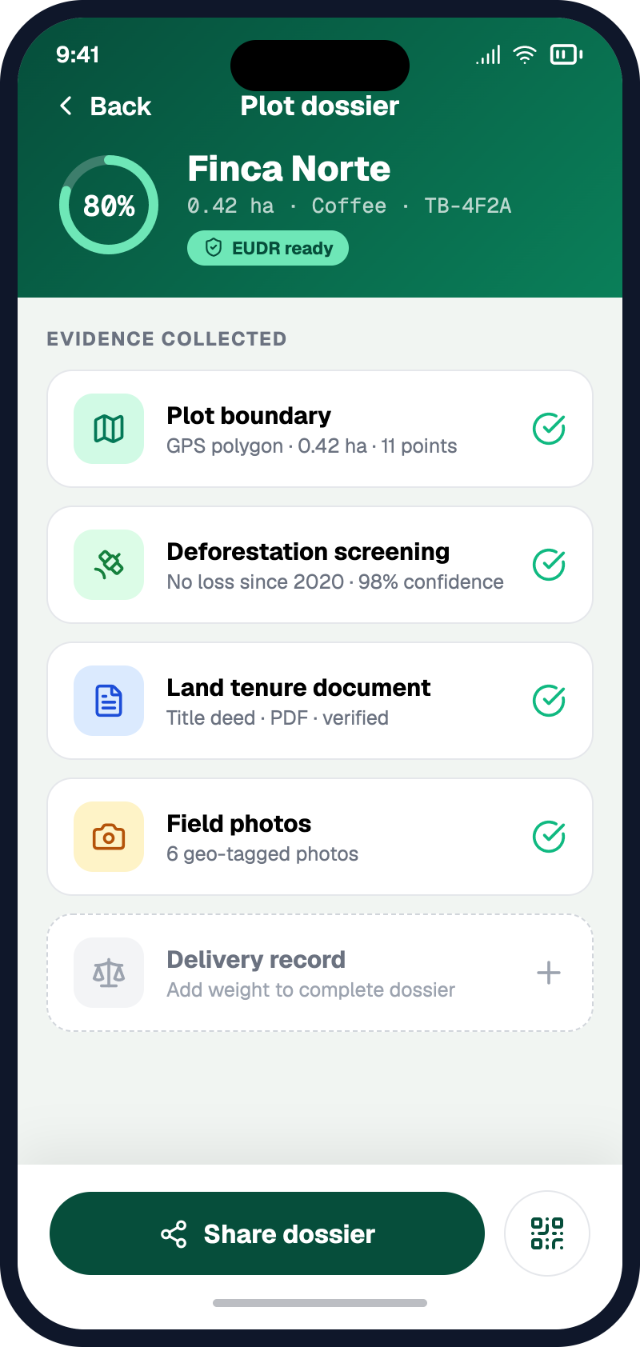
One field network, many commitments
A cooperative that sells to three buyers can face EUDR, one or two certification schemes, a buyer's Scope 3 ask, and an NGO's income survey in the same season. Most of these ask for the same few facts: where the plot is, who farms it, what was delivered, and whether the farmer agreed to share it. Usually each request pays for its own field visit, its own form, and its own spreadsheet. Farmers get asked the same questions four times, and the coop pays for it in staff days.
Tracebud starts from the other end. You capture the farm once, with the producer present, and keep it as a record the network can reuse. Each new programme then takes the shape it needs from that record, and only the facts that are actually missing get collected again.
The spine: field-first, reusable records, programme data readiness
Three ideas sit under the capture-once claim.
Field-first. The producer, or a Field Agent when there is no phone, walks or draws the plot in the Field App. Consent is stored with the record. Capture works offline and syncs later.
Reusable records. Plots, deliveries, households, and consent live on one shared evidence layer. When a buyer is missing something, a cascading request asks the link that owns that fact, not the whole chain.
Programme data readiness. The same records are moulded into the shape a regulation, scheme, or programme asks for. You do not restart field collection every buyer season.
The Field App is for farmers and field agents. The Dashboard is for cooperatives, processors, exporters, importers, brands, and agencies. Tracebud is agri-food chain infrastructure. It is not a certification body and does not issue certificates. Screening runs on real plot records; it is not a satellite-only map.
What one capture contains
On the live EUDR path, one capture produces four kinds of record. The household row is producer identity and membership only; income, labour, and practice fields are co-build work, not already on the household record.
| Record | What it holds (EUDR path) | Why it travels | |---|---|---| | Plot | Geolocation (point or polygon; EUDR expects polygons for plots over 4 ha), producer link, commodity, photos/evidence | Same boundary serves any programme that asks "where" | | Delivery / lot | Quantity, date, receiving organisation, link to contributing plots (Identity Preservation or Segregation) | Same lineage serves any programme that asks "which farm did this come from" | | Household / producer | Producer identity and membership as captured for EUDR | Starting point for household-level programmes (co-build adds the indicators) | | Consent | Who agreed to share what, with whom | Lets a record move downstream without being copied into each buyer's portal |
Live today: EUDR open beta
What you can run today, in open beta:
- Field App + Dashboard for coffee and cocoa networks (the infrastructure handles other commodities too; coffee and cocoa come first)
- Plot-level geolocation and consent at origin, offline when needed, with Field Agent assist for producers without a smartphone
- Geospatial screening on real plot records (it runs on top of farm capture; it does not replace it)
- DDS-style evidence packs, and filing of Due Diligence Statements through the EU Information System from the Dashboard where the product supports it
- Chain of custody through aggregation and processing: Identity Preservation and Segregation are live; CoC Mass Balance is scheduled
- Cascading network requests for gaps in multi-hop chains
"Mass balance" here means the chain-of-custody model, and that model is scheduled, not live. It is not the same thing as balancing inputs and outputs at a processing step.
Application dates in the Commission text: large and medium operators from 30 December 2026, micro and small operators from 30 June 2027. Check your own category against the regulation.
Farmers use the Field App free. Operations dashboards pay an access fee per tonne when they receive a lot, with no seat fees; the agency dashboard is per staff seat. See pricing.
Start here: EUDR compliance · EUDR checklist · plot-level geolocation for DDS evidence · EUDR coffee software shortlist 2026.
Which field facts serve more than one programme
The table below is indicative. It shows which spine records each programme tends to ask about, not that Tracebud meets the programme.
| Fact (spine record) | EUDR (live) | CSDDD | Scope 3 / carbon | Regen | Living income | Human rights | RA / Fairtrade / organic | |---|---|---|---|---|---|---|---| | Plot location / boundary | ● | ○ | ● | ● | ○ | ○ | ● | | Producer / household identity | ● | ● | ○ | ○ | ● | ● | ● | | Delivery-to-plot lineage | ● | ○ | ● | ○ | ○ | ○ | ● | | Consent to share | ● | ● | ● | ● | ● | ● | ● | | Practice / input data | — | ○ | ● | ● | ○ | — | ● | | Income / price / premium | — | ○ | — | ○ | ● | ○ | ○ | | Labour / casework | — | ● | — | — | ○ | ● | ○ |
*Indicative. Programme requirements change and differ by scheme version and buyer. ● = record is a typical input; ○ = sometimes; — = rarely. A ● does not mean Tracebud covers that programme today.*
The first four rows are what the live EUDR path already collects. The last three rows are the co-build work: new fields and packs added to the same records, not a separate app.
Co-build programmes
Designed for, not shipped.
These pages describe how Tracebud is designed for each ask. None of them is a shipped module today. If you bring the ask, we adapt the live EUDR platform with 2–3 partners. Build it with us.
CSDDD
What it typically asks. Companies in scope identify and address adverse human-rights and environmental impacts in their chains of activities, with evidence that reaches upstream. The scope and timing of the directive have been revised through the EU simplification (Omnibus) process; check the current text.
What the EUDR spine already gives you. Producer and plot identity, delivery lineage to a buyer, and consent, so an impact can be tied to a real supplier rather than a country average.
What co-build would add. Risk and casework moulds (grievance, remediation follow-up) that sit on the same producer records.
Status: designed for, not a live module. We're building this mould with a small group of partners.
→ CSDDD
Scope 3
What it typically asks. Buyers need farm-origin activity data, rather than spend-based averages, for purchased goods emissions, often within FLAG-type land-sector guidance.
What the EUDR spine already gives you. Plot location and area, delivery volumes linked to plots, commodity.
What co-build would add. Practice and input fields and a per-lot export a buyer's carbon accounting tool can take in. Tracebud doesn't calculate or certify emissions factors unless a module ships.
Status: designed for, not a live module. We're building this mould with a small group of partners.
→ Scope 3
Carbon accounting
What it typically asks. Plot-level practice evidence and baselines for insetting or project claims, plus a clear chain between farm and claim.
What the EUDR spine already gives you. Boundaries, producer consent, delivery lineage.
What co-build would add. Practice and baseline capture, evidence attachments, and packs shaped to the methodology a partner uses. Not a carbon registry or verifier.
Status: designed for, not a live module. We're building this mould with a small group of partners.
Regenerative agriculture
What it typically asks. Which practices were adopted, on which plots, since when, and what changed against a baseline.
What the EUDR spine already gives you. The plot itself and who farms it, which every practice record has to attach to.
What co-build would add. Practice checklists and follow-up visits on the same plot, so a regen programme doesn't remap farms the EUDR campaign already mapped.
Status: designed for, not a live module. We're building this mould with a small group of partners.
Living income
What it typically asks. Household-level income, prices received, premiums, and comparison to a living-income benchmark.
What the EUDR spine already gives you. Producer/household identity and deliveries (volumes received).
What co-build would add. Receipt- and household-linked income indicators, with consent rules suited to sensitive financial data.
Status: designed for, not a live module. We're building this mould with a small group of partners.
Human rights
What it typically asks. Household and labour evidence, monitoring and remediation records (for example child-labour monitoring in cocoa).
What the EUDR spine already gives you. Household identity, consent model, field-agent capture path.
What co-build would add. Casework patterns with stricter access controls. This data is sensitive. Co-build here starts from data-protection design, not from fields.
Status: designed for, not a live module. We're building this mould with a small group of partners.
Rainforest Alliance
What it typically asks. Certificate holders keep member/farm registers, farm-level data including location, and internal inspection records.
What the EUDR spine already gives you. Member farms, plots, and consent captured once, which can serve both the EUDR duty and the scheme's farm data.
What co-build would add. A scheme-shaped export/pack. Not endorsed by Rainforest Alliance; not a certification body; a certificate doesn't replace the operator's EUDR due diligence.
Status: collect-once intent; scheme pack as co-build.
Fairtrade
What it typically asks. Producer organisations keep member lists, volumes sold, and premium-related records.
What the EUDR spine already gives you. Member and delivery records.
What co-build would add. Premium and member-level packs on the same records. Not endorsed by Fairtrade.
Status: collect-once intent; scheme pack as co-build.
Organic
What it typically asks. Parcel identification, parcel history and conversion status, input records, kept for the control body.
What the EUDR spine already gives you. Parcels (plots) with boundaries and producer link.
What co-build would add. Parcel-history and input moulds. Tracebud is not a control body.
Status: collect-once intent; parcel-history mould as co-build.
→ Organic
Programme not listed? The pattern is the same. Tell us which facts it asks for and we'll show you which ones the spine already holds. See adapt to a programme data ask (deep-link to the FAQ question on adapting Field App and Dashboard to a programme's specific field-data request).
Who this is for
- Cooperatives and exporters that can't pay for a remapping project every season
- Small European and Nordic specialty buyers who need supplier evidence without an IT project → specialty coffee playbook
- Cocoa coops and SME exporters going from member plots to buyer packs → cocoa plots-to-DDS
- Desk teams tracing a batch back to plots → batch-to-plot walkthrough
- Programme officers and scheme partners (certification, NGO, fund, income, regen, human-rights teams) who need farmer field data without building and maintaining their own app
Programme and certification partners
If you run a programme that needs farmer field data (certification scheme, NGO, fund, or buyer sourcing team), you can use the Field App and Dashboard instead of building your own collection stack. Bring your schema or indicators. We mould them onto the records the EUDR path already collects, so farmers don't get a second app or a second visit for facts that already exist.
What we won't do: certify, issue certificates, or claim a scheme endorsement we don't have.
Cost works the same as everywhere else: Field App free for farmers, access fee per tonne for organisations receiving lots. We don't publish savings percentages; compare against what your current field stack costs to keep running.
For what is live today, see Live today: EUDR open beta. For how a mould gets built, see How co-build works.
How co-build works (no fake dates)
- Start on the live EUDR path (open beta), or join a partner network that already uses it: network, plots, consent, screening, DDS-style packs.
- Name the mould. Which facts, which format, who receives it (scheme pack, income indicators, practice records, casework).
- Gap check. We map your ask against what the spine already holds (see the overlap table). Usually some of it already exists, and the rest is the build.
- Build with 2–3 partners. We adapt capture and packs on the same records and test them in a real network.
- Ship or don't. A mould becomes a product claim only when it ships. Until then, the public page says "designed for".
There's no public ship calendar for co-build programmes. If a date isn't in the product, we don't claim it here.
Live vs co-build: FAQ
Is EUDR live on Tracebud?
Yes, in open beta: Field App, Dashboard, plot geolocation, screening on real plots, DDS-style packs, and filing through the EU Information System where the product supports it.
Are CSDDD, Scope 3, carbon, regen, living income, human rights, Rainforest Alliance, Fairtrade or organic live modules?
No. They are designed for and co-built with partners on the EUDR spine. None is a live compliance module.
Does "collect once" mean one certificate covers EUDR?
No. Collect once means one field capture. Each buyer or scheme still gets its own pack, and the operator remains responsible for its EUDR due diligence. A certificate doesn't replace that duty.
Is Tracebud a certification body?
No. It doesn't certify, audit or issue certificates, and it isn't endorsed by the schemes named here.
Is this satellite-only deforestation screening?
No. Screening runs on plot records captured with the producer. Satellite layers support the check; they don't replace farm capture.
Who owns the farm record?
The record is collected with consent and names the producer. Each organisation sees what consent entitles it to see. See data & security.
Is CoC Mass Balance live?
Identity Preservation and Segregation are live. CoC Mass Balance is scheduled, not live.
What does it cost?
Farmers use the Field App free. Operations dashboards pay an access fee per tonne when they receive a lot, with no seat fees; the agency dashboard is per staff seat. See pricing.
Next steps
- Primary: Start on the EUDR open beta
- Secondary: Talk co-build for a programme (pre-fill subject "Co-build: [programme]" if the form supports it)
- Tertiary: EUDR coffee software shortlist 2026 · evaluate EUDR tools for SME chains · collect once for RA / Fairtrade / EUDR · FAQ · What is Tracebud AS?
Tracebud AS · Oslo, Norway · org.nr 937 759 282 · tracebud.com